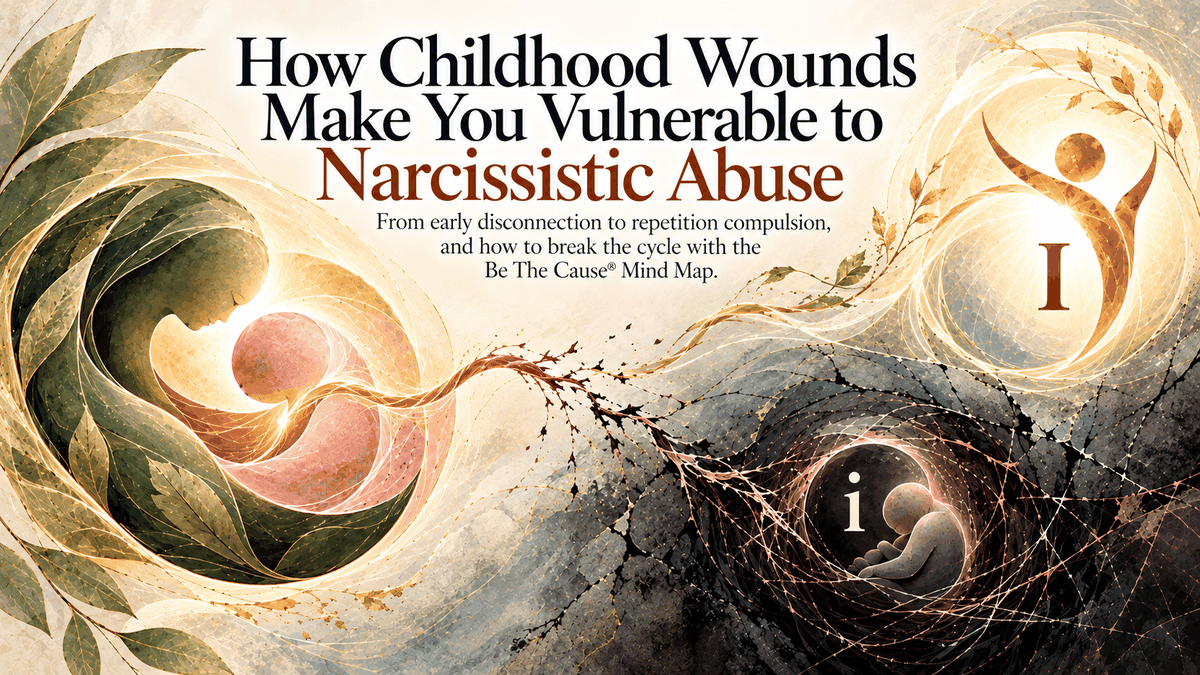
By Dr. Judy Rosenberg, Clinical Psychologist and Creator of the Be The Cause® Mind Map
You may think you became involved with a narcissistic person because you simply chose the wrong partner.
But there is a deeper question: Why did this particular relationship feel so compelling in the first place?
Why did you stay when something inside you knew the relationship was hurting you? Why did you keep trying to earn love, prove your worth, explain yourself, rescue the relationship or finally get the other person to understand you?
The answer may begin long before you ever met that person. It may begin in childhood.
Our earliest relationships help create a blueprint for how we experience love, safety, connection - and ourselves. When those early relationships contain disconnection, neglect, abuse, inconsistency, control or inadequate emotional attunement, we adapt. Those adaptations can follow us into adulthood.
This is one of the central principles behind my Be The Cause® Mind Map: if we want to change the relationships we create in the present, we first need to understand the blueprint encoded in the past.
Decode your past. Recode your future®.
We Begin in Connection
A baby enters the world completely dependent upon connection.
We need more than food, clothing and shelter. We need to be seen, soothed, protected, understood and emotionally mirrored. Our early relationships help shape our developing sense of self and expectations of other people.
When a caregiver responds with warmth and appropriate attunement, the developing child can begin to experience: I matter. My feelings matter. It is safe to need. I can connect without losing myself. I am worthy of love.
But what happens when connection is repeatedly disrupted?
Perhaps the caregiver is emotionally unavailable, frightening, inconsistent or overwhelmed. Perhaps the child is criticized, controlled, shamed, ignored, smothered or expected to meet the emotional needs of the parent.
Childhood wounds can occur through acts of commission - what was done to us, including physical, sexual or verbal abuse, humiliation, rage and excessive control.
They can also occur through acts of omission - what we needed but did not receive: protection, empathy, affection, validation, emotional presence and healthy attunement.
Sometimes what didn't happen is as important as what did.
The Cracked Lens: How Childhood Wounds Become Encoded
A young child does not ordinarily have the psychological perspective to think: "My caregiver has limitations that prevent them from providing what I need."
Instead, the child may conclude: "There must be something wrong with me."
That conclusion becomes part of what I call the cracked lens.
Through that lens, the child may begin encoding beliefs such as: I'm not enough. I'm not lovable. My needs are too much. I have to earn love. If I keep someone happy, they won't leave me. If someone is angry with me, I must have done something wrong. Love means working hard for connection.
These aren't objective truths. They are meanings a child may create in response to painful experiences. But when those meanings remain unconscious, they can influence adult choices in powerful ways.
From the Big I to the little i
I use the Big I to represent the authentic, integrated self - the developing individual who can remain connected to others without losing connection to self.
The little i represents the wounded, reactive self that develops when healthy connection and individuation are disrupted.
Imagine the image at the top of this article. The infant begins in connection. With healthy enough connection, that child gradually separates and individuates - not by losing love, but by developing a stronger sense of self. The child grows toward the Big I.
But when the original connection is repeatedly ruptured, frightened, manipulated or emotionally deprived, the developmental thread can fray.
The person still grows physically, of course, but parts of the emotional blueprint may remain organized around fear, abandonment, shame, approval-seeking or the need to earn connection. That is the territory of the little i.
And it can leave us particularly vulnerable to relationships that reactivate the original wound.
The Hole in the Soul
When essential emotional needs repeatedly go unmet, we can develop what I call a hole in the soul - an internal sense that something essential is missing.
We may spend years trying to fill that hole through achievement, perfectionism, approval, appearance, money, status, caretaking or relationships.
Then someone enters our life and seems to offer precisely what the wounded part of us has been seeking: attention, admiration, intensity, validation, and the feeling of finally being chosen.
This can be especially powerful in relationships involving narcissistic or manipulative patterns, where intense early attention may later give way to inconsistency, criticism, control or emotional withdrawal.
The relationship can feel less like meeting someone new and more like finding the answer to something very old.
Why Familiar Can Feel Like Love
This is where repetition compulsion becomes important.
Freud described our tendency to repeat unresolved experiences rather than simply remember them. I call these moments WTF - What the Freud!
We can unconsciously return to familiar emotional territory, sometimes as though we're trying to finally produce a different ending.
If childhood love required chasing an emotionally unavailable caregiver, emotional unavailability may later feel strangely familiar. If you had to earn attention, you may find yourself trying to earn love again. If your feelings were repeatedly invalidated, you may tolerate someone who continually challenges your perception of reality. If you grew up walking on eggshells, unpredictability may feel familiar rather than immediately unacceptable.
Familiarity is not the same as compatibility. And intensity is not necessarily intimacy.
Understanding this doesn't mean that someone chooses or causes another person's abusive behavior. Responsibility for abusive behavior belongs to the person engaging in it.
But understanding your own blueprint can help explain why certain unhealthy dynamics feel compelling, why leaving can be so difficult and - most importantly - how to stop repeating them.
Listen deeper: browse Dr. Judy WTF radio episodes about childhood wounds, repetition compulsion and narcissistic relationships.
When the Adult Relationship Reopens the Childhood Wound
The relationship may begin with extraordinary connection. You feel seen. Understood. Special. Chosen. Perhaps you've finally found the person who will fill the hole.
And then something changes. Admiration becomes criticism. Connection becomes withdrawal. Certainty becomes confusion. Affection becomes conditional.
You begin working harder. You explain more. You question yourself.
The adult relationship begins activating the childhood blueprint.
The person standing in front of you is different, but the emotional experience can feel hauntingly familiar: Please see me. Please understand me. Please choose me. Please love me.
The adult may appear to be fighting desperately for the current relationship while the little i is still trying to resolve something much older.
Want to Understand the Pattern Beneath the Relationship?
My Healing From Narcissistic Abuse program uses the Be The Cause® Mind Map to help you examine childhood wounds, encoded beliefs and repetitive relationship patterns - not merely to understand the other person, but to understand your own blueprint and how to change it.
The Be The Cause® Mind Map: Finding the Original Blueprint
This is why simply telling someone, "Just leave the narcissist," may not address the entire problem.
Ending an abusive relationship may be necessary for safety and well-being. But physical separation alone doesn't automatically rewrite an internal blueprint.
If we don't understand the pattern, we can change partners while carrying the same cracked lens into the next relationship.
The Be The Cause® Mind Map follows the pattern through nine panels.
Panels 1-3: Decode the Past
- Panel 1 - Wound: What happened?
- Panel 2 - Reaction: How did you react emotionally and behaviorally?
- Panel 3 - Encoding: What did you come to believe about yourself, other people and the world?
Then we examine what that blueprint can create in the present: Panel 4 - Chaos; Panel 5 - Defenses; Panel 6 - Breakdown/Breakthrough.
Finally, we move toward recoding: Panel 7 - Paradigm Shift; Panel 8 - Healing; Panel 9 - Unity.
The question is no longer simply: "Why did I end up with a narcissistic person?"
The deeper questions become: What happened to me? What did I encode because of it? How is that code operating in my life today? And what do I want to encode instead?
Moving From the little i to the Big I
The little i may say: Please don't leave me. Tell me I'm enough. I'll change. I'll try harder. If I love you enough, perhaps you'll finally love me the way I need.
The Big I begins asking different questions: Does this relationship align with who I am? Is there empathy and reciprocity here? Do this person's actions match their words? Can I express my needs without fear? Can I remain connected to myself while being connected to this person?
This is an essential paradigm shift.
Healing isn't about becoming somebody else. It's about recovering the self that became obscured by the wound.
Empathy Heals. Apathy Disconnects.
Healthy relationships allow two realities to exist.
I can understand your feelings without erasing mine. I can love you without abandoning myself. I can disagree with you without destroying you. I can set a boundary without surrendering my humanity.
When a relationship repeatedly requires you to sacrifice your reality in order to preserve the connection, the price of connection has become too high.
Healing means developing empathy for the wounded child within while also learning to recognize whether the people around us are capable of reciprocal, respectful connection.
Empathy heals. Apathy disconnects.
Becoming the Enlightened Witness
Healing also requires what I call an enlightened witness.
Sometimes another person - a therapist, mentor, friend or loved one - helps us see what we couldn't see while we were inside the pattern. Eventually, we learn to become that witness for ourselves.
Instead of asking, "What's wrong with me?" we begin asking, "What happened to me - and what did I encode because of it?"
Instead of, "Why can't I make this person love me?" we ask, "Why am I abandoning myself in order to maintain this connection?"
And instead of, "How do I change the narcissist?" we ask: "How do I become the cause of a better outcome for my own life?"
Decode Your Past. Recode Your Future®.
Your childhood influences you. It does not have to dictate your future.
Understanding childhood wounds isn't about spending the rest of your life blaming your parents, nor is it about defining yourself by what happened to you. It's about understanding causation.
You cannot change what you cannot see.
Once you identify the wound, understand your reaction and uncover the encoding, you can begin dismantling the old blueprint.
You can stop confusing chaos with chemistry. You can stop confusing control with care. You can stop confusing intermittent attention with love. You can stop asking another person to repair an internal wound that existed before they arrived.
And you can begin choosing relationships from the Big I rather than reacting from the wounded little i.
That is how we interrupt repetition. That is how we move from unconscious reaction toward conscious causation. That is how we decode the past and recode the future®.
Ready to Understand Your Own Blueprint?
If you recognize yourself in these patterns, Healing From Narcissistic Abuse takes you through the Be The Cause® Mind Map to help you understand the childhood wounds, encoded beliefs and repetitive relationship patterns that may be keeping you psychologically connected to unhealthy relationships.
The purpose isn't simply to understand the narcissist. The deeper purpose is to understand you - and return to your Big I.
EXPLORE HEALING FROM NARCISSISTIC ABUSE →
For information about the program, call 310-739-4491.
Ready to break the trauma bond and return to your authentic self?
Schedule your free 15-minute consultation with Dr. Judy Rosenberg
Looking for broader mental health support? Visit our main practice: Psychological Healing Center
You don’t have to do this alone. We’ll stand by you as you take the journey back to yourself.